Showing posts with label facebook. Show all posts

Monday, December 5, 2011

GOWALLA SOLD TO FACEBOOK


Facebook has acquired location sharing service Gowalla for an undisclosed sum, according to a source close to Gowalla. Facebook declined to comment on the deal. "We don't comment on rumor and speculation," a company spokesman said.

Launched in 2009, Austin-based Gowalla went head-to-head with direct rival Foursquare -- and lost. Badly trailing Foursquare in user adoption, Gowalla recently shifted directions, recasting itself as a travel guide.

Wednesday, November 30, 2011

GOOGLE VIDEO SITES GET 21 BILLION VIEWS PER MONTH


The latest report from comScore makes for eye popping reading -- Google's video sites, of which YouTube is the most important, received 20,933,113,000 views in October. To put that into some context, that's roughly three videos watched by every person alive on the planet. According to the statistics, YouTubers spent an average of seven hours watching the month's hottest videos.

Surprisingly, Facebook came second, but viewers spent an measly average of 18 minutes watching last night's karaoke. In other news, Hulu came top for online advertising and Vevo was the most watched partner site, you guys obviously love your Lady Gaga.

FACEBOOK AGREES TO PRIVACY AUDITS FOR 20 YEARS TO SETTLE SUIT BY FTC


Facebook settled a privacy lawsuit with the Federal Trade Commission on Friday and agreed to submit to independent audits for the next 20 years. The FTC had accused the social network of being deceptive in its privacy practices, Reuters reported. ”Facebook’s innovation does not have to come at the expense of consumer privacy,” FTC Chairman Jon Leibowitz said. Facebook will create two positions dedicated to privacy, including a chief privacy officer.

In addition, Reuters said the social network must be transparent about what it does with personal user data in the future and it must receive user permission before changing how it shares private user data. Facebook CEO Mark Zuckerberg said he “is committed to making Facebook the leader in transparency and control around privacy.

Tuesday, November 29, 2011

RUMOR: FACEBOOK GOING PUBLIC BETWEEN APRIL AND JUNE 2012


Facebook Inc. is inching closer to an initial public offering that it hopes will value the company at more than $100 billion, according to people familiar with the matter. The social networking firm is now targeting a time frame of April to June 2012 for an initial public offering, said people familiar with the matter. The company is exploring raising $10 billion in its IPO, in a deal that might assign Facebook a $100 billion valuation.

A Facebook IPO has been hotly anticipated for several years, and viewed as a defining moment for the latest Web investing boom. The company has been vague about whether it would even make such an offering and silent on timing of an IPO. "We're not going to participate in speculation about an IPO," said Facebook spokesman Larry Yu.
The company now appears poised to go ahead with a deal.

Facebook Chief Executive Mark Zuckerberg has in the past publicly expressed reluctance to do an IPO. And he has opted to keep Facebook private longer than many suspected he would. But he is warming to the idea. Facebook is now in internal discussions over the timing of its filing with the Securities and Exchange Commission, and is considering filing dates as early as this year, said these people. Mr. Zuckerberg hasn't made any final decisions, these people cautioned. [Wall Street Journal]


Monday, November 14, 2011

AMAZON BRINGING 400 MAGAZINES AND NEWSAPERS TO FIRE ALONG WITH "THOUSANDS" OF APPS


Last week Amazon announced they would be bringing Facebook, Hulu and "several thousand" other apps to their upcoming Kindle Fire tablet. Now, they are announcing that more than 400 "full-color" titles will be available on the Kindle Fire Newsstand, including Us Weekly, The New Yorker and Reader's Digest, among others. Users who subscriber before March 1st, meanwhile, will be able to access a full 17 Condé Nast titles for free, as part of a three-month offer.

Monday, October 31, 2011

FACEBOOK TESTING 'TRUSTED FRIENDS' PASSWORD UNLOCK FEATURE


Over the coming weeks Facebook will begin testing a 'Trusted Friends' password unlock feature. The feature will allow a user to select between three and five pals that they're confident will help out in dire times. Then, should you lose your password, Facebook can send recovery codes to that gang, and they can hand 'em over to you in order to unlock things. According to Facebook, it's akin to "giving a house key to your friends when you go on vacation."

Wednesday, October 26, 2011

ANONYMOUS SAYS IT IS GOING AFTER THREE TARGETS ON NOVEMBER 5TH


November 5, known as Guy Fawkes Day in Britain, is a special day for Anonymous. And this November 5, Anonymous is celebrating by saying it will make three different raids: an attack on the social media giant Facebook, a physical protest against banks, and an assault on right-wing news network Fox News.

In "Operation Facebook", Anonymous is targeting Facebook for their inadequate privacy settings and for “selling information to government agencies and giving clandestine access to information security firms so they can spy on people from all around the world.” There has been some confusion, even on the part of Anonymous if this operation will actually take place. A call-to-arms video was refuted by a tweet by AnonOps, the Twitter stream of Anonymous Operations, only to be partially retracted with another tweet explaining that some members still might partake in the raid.

"Operation Cash Back" or "Operation Cash Run", both names are used for the same thing, was announced two weeks ago via YouTube video, and the call-to-arms has already been duplicated various times. Both are is reminiscent of the “Move Your Money” project, which asks supporters to close down their accounts with large international banks. They also coincide with Bank Transfer Day, a Facebook group with over 25,000 like, which has a similar objective. Operation Cash Run will both strengthen your community and weaken the forces of global corruption” says the modulated anonymous voice in the Operation Cash Run video. The Operation Cash Back video shares a similar message, and even links to the Bank Transfer Day Facebook page.

The third activity is dubbed "Operation Fox Hunt" and is designed to go after Fox News. The first video calls Fox News’ broadcasts “conservative right-wing propaganda” and states that Anonymous is motivated to punish Fox news for “belittling” Occupy movement protesters. “I've always looked at Fox News as publishing news that borderline Libel (the publication of matter in a defamatory manner). It would be nice for someone to show the truth for once and not the skewed version of it” wrote Bolderdash in a supportive comment on a Reddit thread about the video.

At time of publication, Fox News had yet to make a statement regarding the “Operation Fox Hunt” videos.

Saturday, October 15, 2011

GOOGLE BUZZ GOES BYE BYE


Google announced on Friday that it is shutting down a number of properties in the coming months, the most notable of which is likely its failed social network, Google Buzz. Best known as that annoying thing under “Inbox” in Gmail, Google Buzz was a Twitter-like service that never gained traction. Buzz encouraged users to share status updates, photos and more that could then be viewed by friends in real time, however it offered no compelling features compared to already established services such as Facebook and Twitter.

Google will also shutter several additional services in the near future, including Jaiku, a social network the company acquired in 2007, and Code search, a tool that helped programmers search for open source code. Google Buzz will shut down in the coming weeks while Jaiku and Code Search will both go offline on January 15th, 2012 along with a few other seldom-used Google services.

Saturday, October 1, 2011

NINE PRIVACY GROUPS ASK FTC TO INVESTIGATE FACEBOOK


The American Civil Liberties Union, the Electronic Privacy Information Center (EPIC) and seven other privacy groups have contacted the U.S. Federal Trade Commission asking it to investigate Facebook for “secretly tracking users after they logged off of Facebook’s webpage.” A 34-page complaint filed by EPIC asks for an injunction, investigation and “other relief” from the social network. EPIC said Facebook is home to more than 60 billion photographs and alleges it developed its “tag suggestions” feature to collect data on Facebook users “without knowledge of consent in order to develop facial recognition technology.” The complaint specifically states:
Given these extraordinary circumstances, the Electronic Privacy Information Center, The Center for Digital Democracy, Consumer Watchdog, and the Privacy Rights Clearinghouse, urge the Commission to investigate Facebook, determine the extent of the harm to consumer privacy and safety, require Facebook to cease collection and use of users’ biometric data without their affirmative opt-in consent, require Facebook to give users meaningful control over their personal information, establish appropriate security safeguards, limit the disclosure of user information to third parties, and seek appropriate injunctive and compensatory relief.

EPIC’s letter also details how the social network violates its own terms of service and shows how hard it is for a user who has been tagged in a photo to delete the original image which, in most cases, is owned by somebody else. EPIC wants Facebook to create a detailed privacy program and to immediately suspend its face-tagging feature.

Tuesday, September 27, 2011

SPOTIFY REQUIRES NEW USERS TO USE FACEBOOK TO SIGN IN TO SERVICE


Spotify has been taking a great deal of flak today about a change made to the service that forces newly registered users to log in using their Facebook IDs. The streaming music service has just released a new statement giving its official response to complaints about the new system, updating a statement released earlier today.
To us, this is all about creating an amazing new world of music discovery. As most of our users are already social and have already connected to Facebook, it seemed logical to integrate Spotify and Facebook logins. We already use Facebook as part of our backend to power our social features and by adopting Facebook’s login, we’ve created a simple and seamless social experience.

From today, all new Spotify users will need to have a Facebook account to join Spotify. Think of it as like a virtual ‘passport’, designed to make the experience smoother and easier, with one less username and password to remember. You don’t need to connect to Facebook and if you do decide to, you can always control what you share and don’t share by changing your Spotify settings at any time.

We’re constantly trying new things, always looking for feedback and we’re always going to listen to our users, making changes based on this feedback wherever we can.”

That seems to hint at potential changes to the new policy if the complaints persist.

FACEBOOK TRIES TO EXPLAIN WHY THEY TRACK USERS EVEN AFTER THEY SIGN OUT


Cookies have been a feature of the web for as long as I can remember. In many cases they are a useful feature to have as they remember your preferences and limit the amount of times you need to login to a service you have signed up for. But there is a dark side to cookie use in the form of them tracking where you go.

The advice to anyone concerned about tracking through cookies is to use a good cookie clean-up utility and log out of sites you believe to be tracking you around the web. But in the case of Facebook it turns out that logging out of your account is not enough–Facebook continues to track you.

This is possible because when you log out of Facebook the associated cookies are not deleted off your machine. So, any site you visit that has a connection to Facebook e.g. the Like button that is now so common, will proceed to check if you have a Facebook cookie. If you do, it can pick up the information and know you’ve visited that site. This logged out tracking was discovered by the Australian writer and hacker Nik Cubrilovic and confirmed logging out is no longer enough.

On Nik’s post where he detailed his findings, Facebook engineer Gregg Stefancik took the time to respond in the comments section. The point he made is that yes, Facebook does track logged out users, but it has good reason to do so. When you log out, the remaining Facebook cookies become a different tool for the social network. Stefancik states they are useful for blocking spammers and phishers, stopping underage users from re-registering with a fake birth date, continuing to keep login approvals and notifications secure, keeping track of shared computer logins, and as a way of helping in the recovery of hacked accounts.

So while Facebook “tracking” when logged out of your account may seem like cause for concern, it in fact turns out to be part of a wider security effort for the social network. Stefancik also states that logging out of Facebook does delete “account-specific cookies” and those that are left do not allow for personal identity tracking. Stefancik’s main point is that Facebook does not share or sell the information it gathers, nor does it use the information for its own advertising or partners. In fact, he states that Facebook does not carry out any tracking at all, at least not in the usual way.

Friday, September 23, 2011

FACEBOOK UNVEILS TIMELINE, COZIES UP TO NETFLIX AND SPOTIFY


During the F8 conference on Thursday, Facebook’s CEO Mark Zuckerberg took the stage to introduce a host of new features that are rolling out to the social network. The major change is called “Timeline” and it takes advantage of existing pictures and status updates to create a more visual experience of “who you are.” As you scroll down your personal timeline, you’ll be able to view pictures and updates throughout the years. There is a new option in the upper right-hand side of your profile to quickly skip to a year in time too, and many of the features are also available on Facebook’s mobile applications.

Timeline automatically hides information that Facebook doesn’t think is important, but if it is, you can easily switch it to show that content. In addition, users can click the Timeline and add photos to earlier points in time before Facebook existed, such as their childhoods. Apps can also populate the timeline.

Zuckerberg also stated that users can now listen to music, read news, and watch TV and movies right through Facebook. For some of the content, you can simply hover over your friends’ post that shows up in your news Ticker and instantly have access to that content. For example, if you see that a friend of yours is listening to REM via Spotify, you can simply click on their post and be instantly connected to the song they’re listening to and listen along with them. Then, you can open up your chat and talk with your friend about how sad you are that REM finally broke up.

Saturday, September 10, 2011

JUDGE RULES FOR EMPLOYEES FIRED OVER FACEBOOK POSTS


The National Labor Relations Board has weighed in on the role of social networking at the office, determining that employees can't be fired for what they post on Facebook -- as long as they use the platform to talk about improving their workplace. The NLRB's ruling, announced on Wednesday, stems from an incident last year, when an employee at the Hispanics United of Buffalo non-profit organization went on Facebook to complain about a co-worker who accused her of slacking off at the office. Other colleagues soon chimed in on the woman's wall post with a slew of profanity-laced comments, before the targeted employee noticed the thread and reported it to a supervisor. Citing the agency's zero-tolerance policy on cyber harassment, the boss fired the five employees who participated in the online discussion -- including one who went on to file a complaint with the NLRB. Last week, administrative law Judge Arthur Amchan finally issued a verdict in the case, determining that the employees retained the right to talk about "their terms and conditions of employment," as stipulated under the National Labor Relations Act. Because this particular Facebook thread involved discussion of "job performance and staffing levels," Amchan ordered Hispanics United to reinstate the employees.

The decision marks the first time that an administrative judge has ruled on a Facebook-related workplace case, though the NLRB says it's received "an increasing number of charges related to social media in the past year" -- so it likely won't be the last.

Tuesday, August 30, 2011

FACEBOOK SHELVES "FACEBOOK DEALS"


Facebook has decided to shelve its Facebook Deals product, a service that was launched to compete with other coupon service providers such as Groupon and LivingSocial. “After testing Deals for four months, we’ve decided to end our Deals product in the coming weeks,” Facebook told Reuters. “We think there is a lot of power in a social approach to driving people into local businesses. We’ve learned a lot from our test and we’ll continue to evaluate how to best serve local businesses.” Facebook will instead focus on Pages, Sponsored Stories and its Ads product. Facebook announced Deals in November and began testing the service in Atlanta, Austin, Dallas, San Diego and San Francisco. It partnered with aDealio, Gilt City, HomeRun, kgb deals, OpenTable, Plum District, PopSugar City, ReachLocal, Tippr, viagogo and zozi to power the service.

Thursday, August 25, 2011

TICKETMASTER AND FACEBOOK TEAM UP FOR SOCIAL SEATING


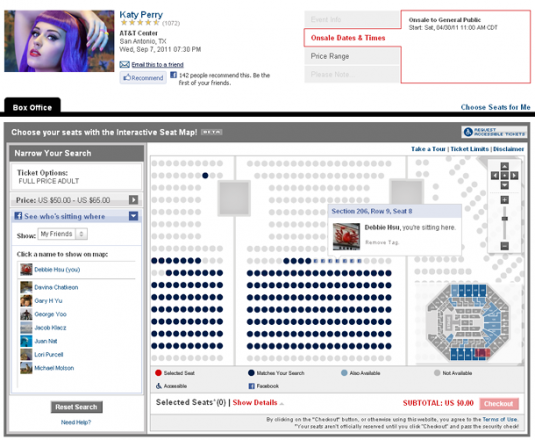
One of the biggest hassles about buying tickets to a concert is getting your friends to buy when you do. With major arena shows, like Katy Perry or Bob Dylan, for example, there are literally thousands of seats to fill and if you don’t buy you and your friends’ tickets together, there’s a good chance you’ll be sitting across the stadium from each other. But there may be an easier way. Today, Ticketmaster announced that it has teamed up with Facebook to make buying tickets a little easier.

Ticketmaster rolled out its interactive seat maps feature about a year ago, but the company just released a new interactive seating map feature that lets ticket buyers see where their friends are sitting. To do this, you have to connect your Facebook account to Ticketmaster, and then when you get to the part of the ticket-buying process where you have an option to choose your seats, you can look at where your Facebook friends are sitting, as well as anyone else on Facebook who made their seat location public.

Once you buy your ticket, you’ll have the option of making your seat location public to everyone, your friends, or no one. Also, if you’ve already bought tickets to something, you can go back in and tag your seat number. The sat map will show tiny Facebook flags to denote your friends’ seats. You can hover over the flag to see who’s sitting there, which can be creepy if you accidentally make your seat location public and anyone buying a ticket can see where you’ll be sitting.

The interactive seat map will let you buy the closest ticket possible to your friend, but there’s no guarantee that even if you try to buy a ticket a half an hour after your friend that there will be seats nearby. Also, for the shows where pricing is tiered from the cheapo nose-bleed seats to the expensive orchestra seats, you may be upset to find your friends can afford nicer seats than you.

Saturday, August 20, 2011

FACEBOOK'S LIKE BUTTON DECLARED ILLEGAL IN GERMAN STATE


Germany has a long tradition of using laws to protect its citizen’s privacy. Home owners, for example, can ask Google to pixelate their houses in Street View (maybe so that their garden gnomes can stay incognito?). Facebook’s facial recognition feature has also come under fire in recent weeks.

The latest target of Germany’s privacy advocates is Facebook’s ‘like’ button („Gefällt mir,“ in German). Thilo Weichert, the head of the Independent Centre for Privacy Protection of the northern German state of Schleswig-Holstein, argues that Internet sites based in his state that use the ‘like’ button are illegally sending this data to Facebook, which in turn uses it to illegally create a profile of its users web habits.

Weichert argues that data from any user who clicks the ‘like’ button – including those who are not Facebook users (which seems to be the crux of the problem for Weichert) – is immediately transmitted to a server in the United States. Weichert told German newspaper FAZ that his concern is that “Facebook can track every click on a site, how long I’m there, what I’m interested in.”

According to the Independent Centre for Privacy Protection’s press release, Facebook uses this data to create “a broad individual and for members even a personalised profile. Such a profiling infringes German and European data protection law. There is no sufficient information of users and there is no choice; the wording in the conditions of use and privacy statements of Facebook does not nearly meet the legal requirements relevant for compliance of legal notice, privacy consent and general terms of use.”

German websites based in the state of Schleswig-Holstein have until the end of September to remove Facebook‘s ‘like’ button or face a fine of up to 50,000 Euro.

Saturday, August 13, 2011

SOCIAL MEDIA CRACK DOWN BEGINS IN UK, TEEN ARRESTED FOR BBM


Lending further gravity to the proposed crackdown being bandied about in British parliament, an Essex teen has been arrested for sending a BBM that ran afoul of the Serious Crime Act of 2007. The 18-year old, now free on bail, allegedly used the service to encourage copycat attacks of the violent rioting that's swept London, and is set to appear in court on September 1st. It's the second known case to put RIM's private messaging service -- "popular among urban teenagers" as a cheap texting alternative -- in the UK's legal hotseat. For its part, the Canadian electronics maker has since reached out to police, promising to aid the investigation "in any way [it] can." Although no decision has yet been made to extend law enforcement's powers over social media services, such as Twitter and Facebook, arrests like these seem to indicate a murky free speech future.

Sunday, August 7, 2011

FACEBOOK RELEASES ACTUAL CONTRACT IN CEGLIA LAWSUIT


On Friday, Facebook’s lawyers made news when they told a court hearing a lawsuit brought by the alleged initial investor in Facebook, Paul Ceglia, that they’d found the “smoking gun” proving the alleged investment contract was a fraud.

Facebook says they’ve found the “authentic contract” between Ceglia and Zuckerberg. Facebook is also charging that Ceglia, who they say is now living in Ireland, is holding back electronic storage devices he intentionally tried to hide from them.

Both parties agree that in 2003 Ceglia hired Zuckerberg, then a Harvard undergrad, to do work for his StreetFax company. But Ceglia filed suit in 2010, saying the contract also included $1,000 initial funding for Facebook, and that he’s entitled to more than half of the social networking giant.

Facebook argues the contract Ceglia produced electronically is a forgery and that Ceglia is a known con artist.

And now Facebook says that in the course of discovery — where Ceglia’s lawyers turned over to Facebook a number of computers and hard drives — that it has found the original “authentic contract” and proof that there are other “storage devices” that Ceglia is intentionally hiding from them in violation of a court order.

But the problem is Ceglia is claiming the “authentic contract” is shielded from use in the suit by designating them as “confidential” under the rules of an agreement between the two parties. Facebook is asking the federal judge overseeing the case in New York State to overrule that designation, in a detailed Friday filing where many of the documents were completely redacted due to the claims of confidentiality.

If indeed Facebook has a copy of the “authentic contract” and it does not include any investment in Facebook, the social networking giant could be close to finally putting aside the legal dramas over the site’s founding in 2004. Earlier this year, the Winkelvoss twins, who was made famous by the movie “The Social Network,” declined to ask the Supreme Court to let them re-litigate their settlement with Facebook over Zuckerberg’s alleged theft of their idea.

Sunday, July 31, 2011

MISSOURI TO FORBID TEACHERS AND STUDENTS FROM BEING FRIENDS ON SOCIAL NETWORKS


If you’re a student living in Missouri, you’d better not be Facebook friends with any of your teachers – that will soon be illegal.

According to Missouri Senate Bill 54 that goes into effect on August 28, any social networking — not just Facebook — is prohibited between teachers and students. It’s all part of an effort to “more clearly define teacher-student boundaries.” However, KSPR reports that It’s only direct social media contact that’s prohibited; teachers are allowed to create Facebook Pages where all students have direct access to the teacher in a more public setting.

CROWD SOURCED CONSTITUTION SUBMITTED TO ICELAND'S GOVERNMENT FOR APPROVAL


A committee of 25 Icelanders submitted the first draft of a rewritten constitution to the country's parliamentary speaker Friday. The democratic experiment bravely asked citizens to log on to Facebook, Flickr, YouTube, and Twitter to engage with the committee in a discussion about the nation's future.

While the project's Facebook page played host to pleads for free ice cream and more volcanoes, the constitution's creators managed to stay on task, focusing on issues of decentralization and transparency in government. The draft is slated for review beginning October 1st.
gay-blog-member-of-the-best-gay-bloggers